
 For New Traders
 For Breakeven Traders
 For Profitable Traders
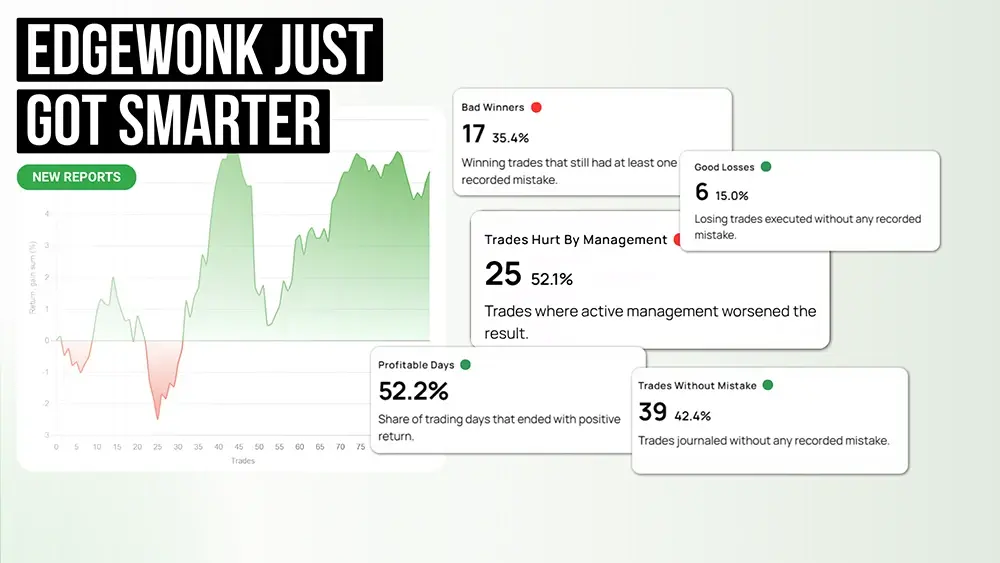
Edgewonk Adds Deeper Trading Analytics to Chart Lab
This week, Edgewonk received one major upgrade.
20 min read
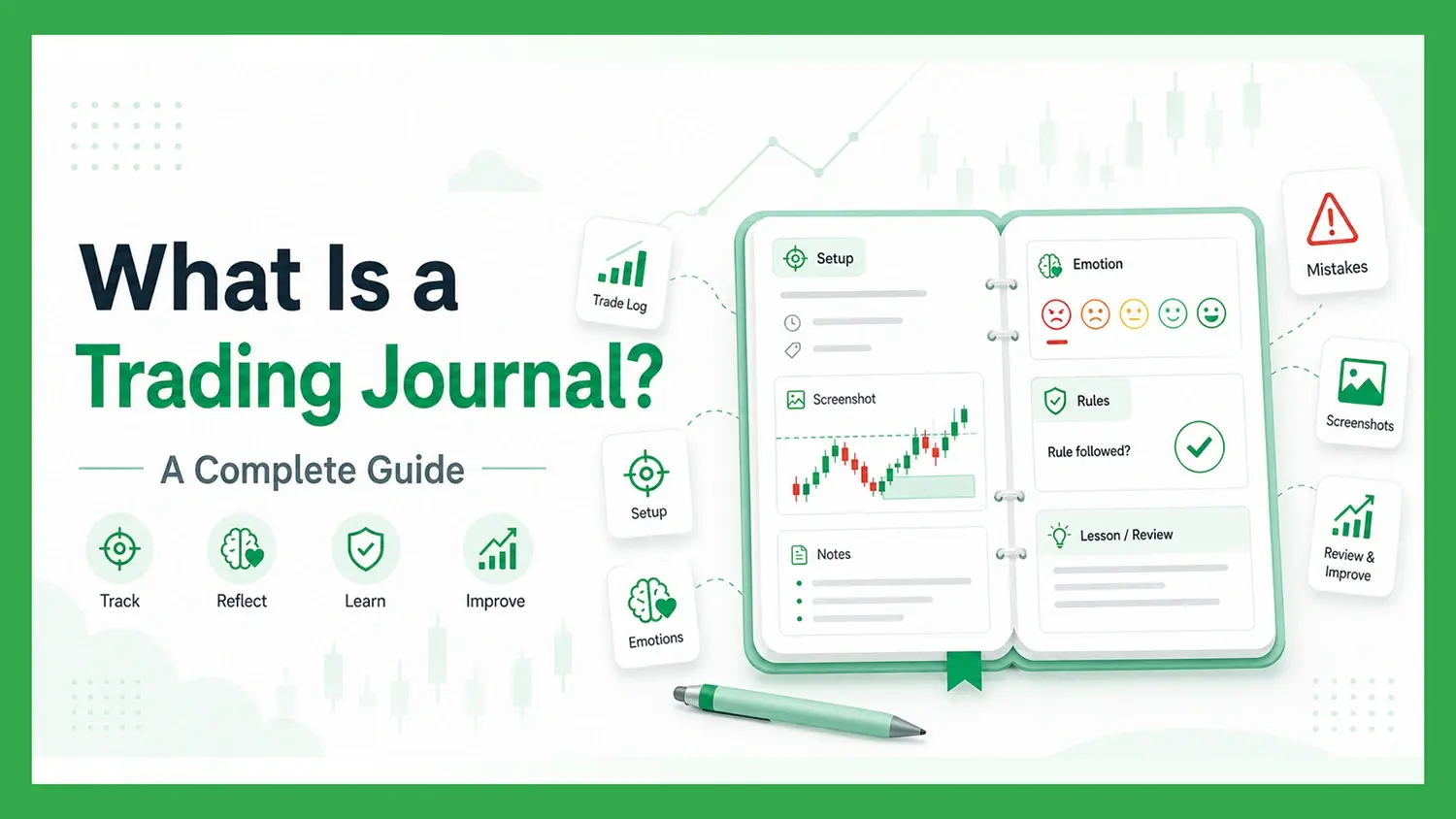
A trading journal is one of the most important tools a trader can use to improve their performance. It helps you record your trades, review your decisions, identify repeated mistakes, and understand what is actually working in your trading.
But a good trading journal is much more than a simple list of entries and exits.
A proper trading journal helps you answer the questions that really matter:
In simple terms, a trading journal is a structured feedback system. It turns your trading history into useful information, so you can make better decisions based on data instead of memory, emotions, or guesswork.
This guide explains what a trading journal is, what you should track, how to review your trades, which mistakes to avoid, and when it makes sense to move from a spreadsheet to dedicated trading journal software like Edgewonk.
A trading journal is a structured record of your trades, decisions, emotions, mistakes, and performance patterns.
Most traders think of a journal as a place where they enter basic trade information:
That information is useful, but it is only the starting point.
A real trading journal goes deeper. It helps you understand why you took a trade, how well you followed your plan, what happened during the trade, how you managed the position, and what you can learn from the outcome.
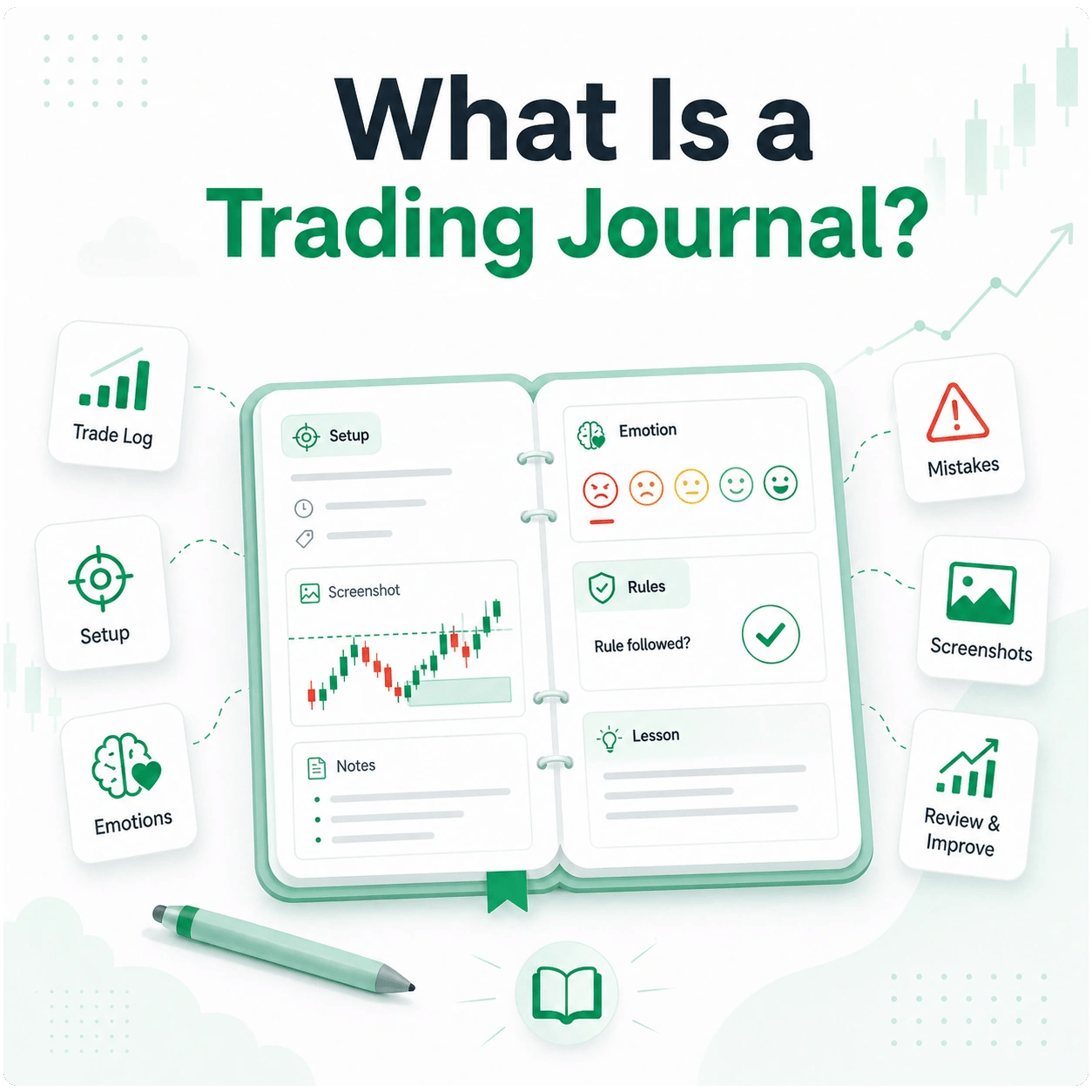
A good trading journal should include:
This is what separates a trading journal from a simple trade log.
A trade log tells you what happened.
A trading journal helps you understand why it happened.
That difference matters because trading improvement does not come from collecting random data. Improvement comes from reviewing the right, personalized information and turning it into better decisions.
For example, knowing that you lost money on a trade is not enough. You need to know whether the loss came from a valid setup that simply did not work, a poor entry, emotional trade management, bad risk sizing, or a broken rule.
Without a journal, those details disappear quickly. You may remember the outcome, but you forget the decision process.
With a structured trading journal, you can go back and study your trades objectively. Over time, the journal reveals patterns that are almost impossible to see while trading live.
This is also why many traders eventually move from simple spreadsheets to a dedicated online trading journal like Edgewonk. Once you want to review setups, mistakes, emotions, screenshots, trade management, and long-term performance patterns, structure becomes essential.
For a deeper breakdown of the exact information to include, read our guide on what to write in a trading journal.
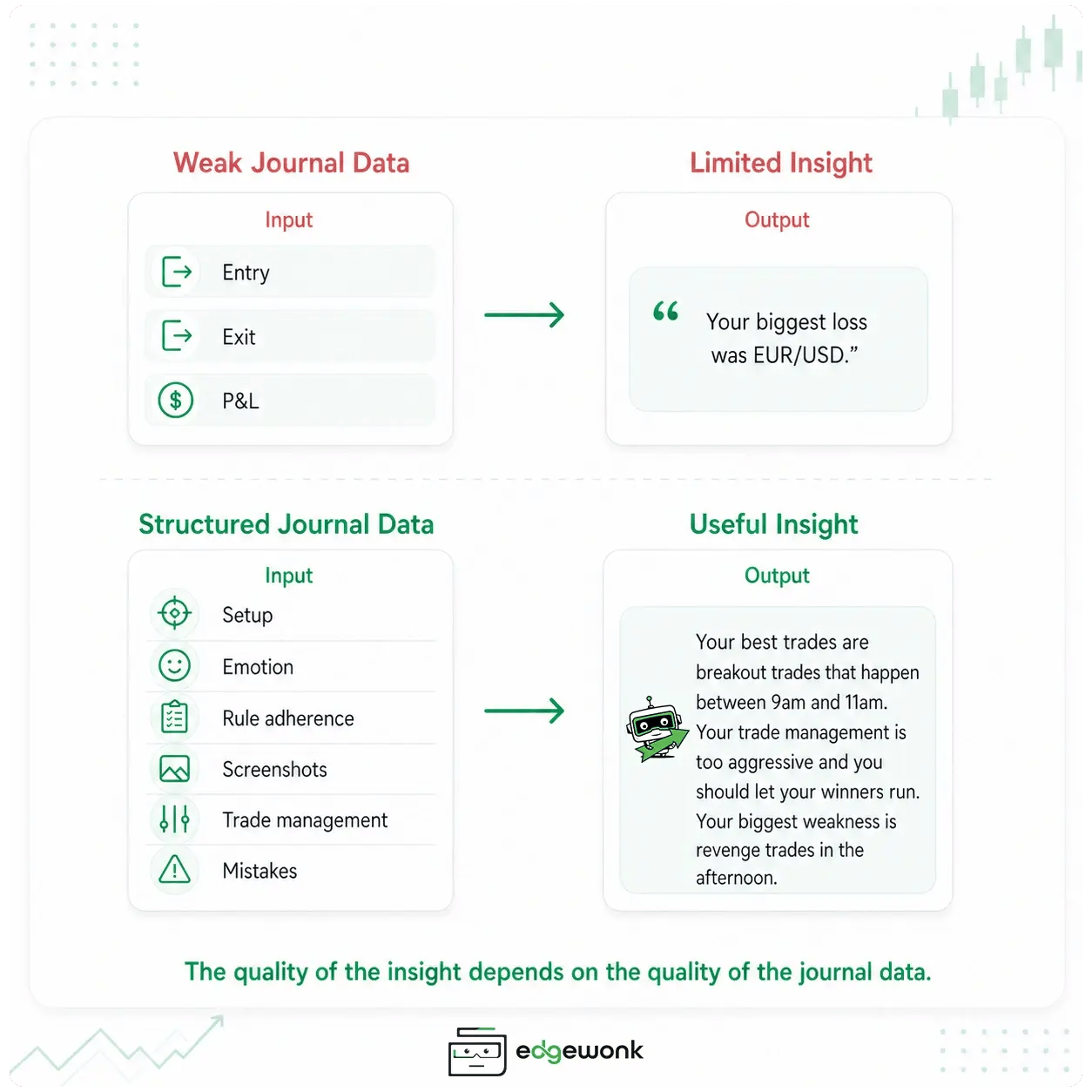
Most traders do not lose because they lack information. They struggle because they repeat the same mistakes without seeing the pattern.
A trading journal helps solve that problem.
It gives you a structured way to review your behavior, your strategy, and your decision making. Instead of judging your trading based on a few recent wins or losses, you can look at the bigger picture.
Traders often rely on memory.
They remember the big winner.
They remember the painful loss.
They remember the setup that “always works.”
They remember the trade they should have taken but missed.
The problem is that memory is selective.
After a winning streak, a trader may feel that their strategy is much better than it really is. After a losing streak, the same trader may think the system is broken, even if the data does not support that conclusion.

A journal creates an objective record. It shows what actually happened, not just what you remember.
This allows you to review your trading with more clarity.
Many traders trade multiple setups, instruments, timeframes, or markets at the same time.
Without a journal, it is difficult to know which part of the trading approach is creating results.
A journal can help you discover:
This is where the journal becomes more than a record keeping tool. It becomes a performance analysis tool.
A trader may believe that all setups are equally important. But after reviewing the journal, they may find that only one or two setups generate most of the profits, while the rest create noise, stress, and unnecessary losses.
That insight can change the entire trading process.
One mistake is not always a major problem. Repeated mistakes are different.
A trading journal helps you identify whether the same problems keep appearing.
Common examples include:
Most traders know some of their mistakes. But they often underestimate how often those mistakes happen and how much they cost.
A trading journal makes those patterns visible.
Discipline is difficult to improve when it is not measured.
Many traders say they want to become more disciplined, but they do not track whether they actually follow their rules.
A trading journal changes that.
You can track whether each trade followed your plan, whether your entry was valid, whether your stop loss was respected, whether your position size was correct, and whether your exit matched your strategy.
Over time, this gives you a clear picture of your execution quality.
You may discover that your strategy works well when you follow the rules, but performs poorly when you interfere with trades emotionally. Or you may discover that even perfect discipline does not improve the outcome, which could mean the strategy itself needs work.
Both insights are valuable.
A common problem among struggling traders is that they try to fix everything at once.
They change the strategy, the indicators, the timeframe, the market, the stop loss, the target, and the risk rules all at the same time.
This creates confusion.
A trading journal helps you identify the highest impact area for improvement. Instead of randomly changing everything, you can focus on one specific issue.
For example:
This creates a more structured improvement process.
Edgewonk was built around this idea. Traders do not need more random opinions. They need a structured way to understand their own trading data and turn it into clear next steps.
A trade log comes from your broker or is a self-made spreadsheet and it just records the numbers. A trading journal explains the decisions behind those numbers.
Both are useful, but they are not the same.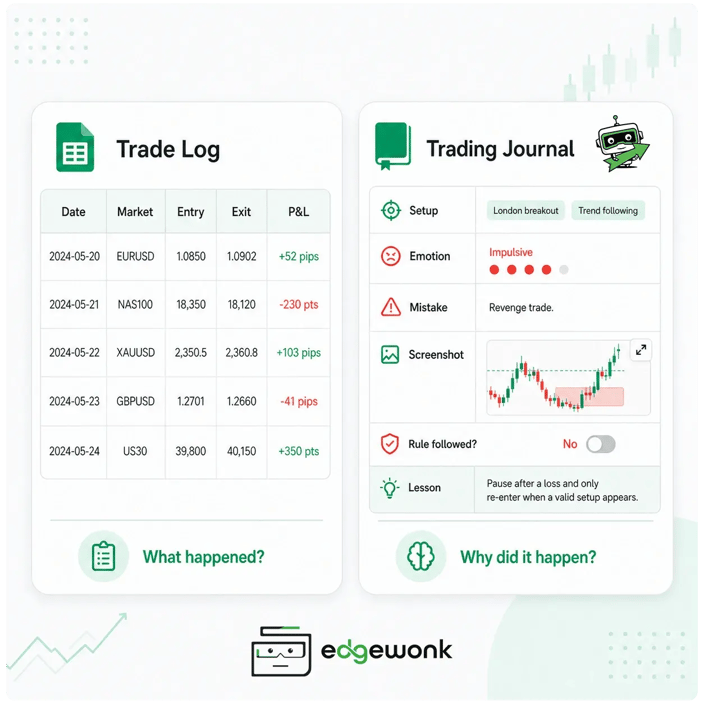
A trade log usually tracks basic information about each trade:
This information is important because it creates the foundation for performance tracking.
But a trade log does not usually explain the quality of the trade. It does not tell you whether the trade followed your plan, whether the setup was valid, whether you were emotional, or whether the outcome was caused by good process or random luck.
A trading journal adds that missing layer.
|
Trade Log |
Trading Journal |
|
Records basic trade data |
Records trade data, context, and decision quality |
|
Focuses on entry, exit, and result |
Focuses on process, behavior, and improvement |
|
Shows what happened |
Helps explain why it happened |
|
Useful for basic tracking |
Useful for performance development |
|
Often simple and numerical |
Often includes notes, tags, screenshots, and review data |
A trade log may show that you lost money on five trades.
A trading journal may show that four of those trades were taken outside your strategy, three were entered too early, and two happened after a previous loss.
That is a very different insight.
This is why a trade log is a useful starting point, but not the complete solution. Once you want to improve your trading process, you need more than numbers. You need context.
A good trading journal captures the numbers, the setup, the context, the decision process, and the lesson from each trade.
The exact structure depends on your strategy and market, but most traders should track five categories of information.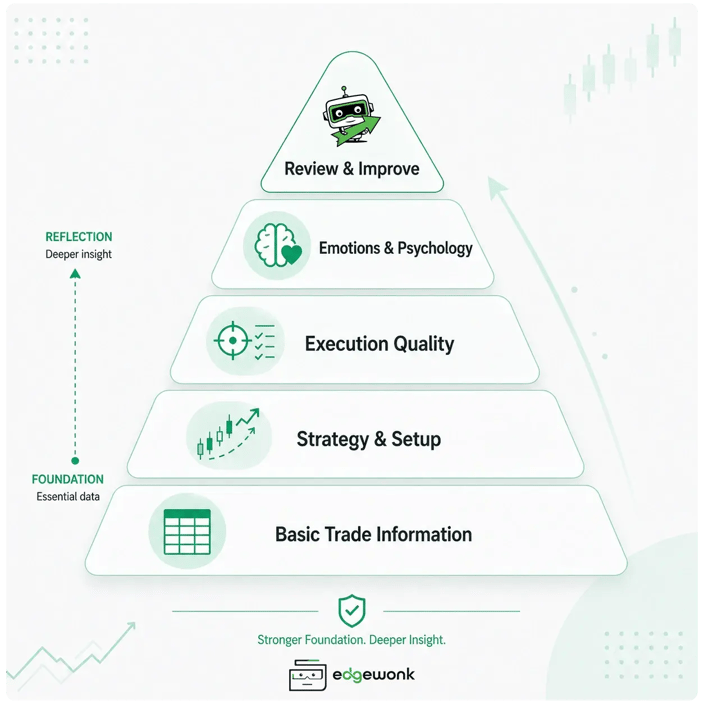
1. Basic Trade Information
This is the foundation of the journal and it is done automatically within Edgewonk.
You should track:
This data helps you calculate your performance and review your trading history.
However, this information alone is not enough. It tells you what happened, but not why it happened.
2. Strategy and Setup
Every trade should be connected to a clear reason. This is where a professional trading journal comes in as it offers traders a place to record and analyze customized and relevant data.
You should track:
This helps you understand which setups actually perform well.
Many traders believe they are trading a strategy, but when they review their journal, they realize that their trades are not consistent. They may be using different entry signals, changing their stop placement, or taking setups that do not match their plan.
A trading journal creates accountability.
If you cannot clearly describe why you entered the trade, the trade may not belong in your strategy.
3. Execution Quality
Execution quality is one of the most important parts of a trading journal.
You should track whether you followed your rules.
Ask yourself:
This helps you separate strategy performance from trader behavior.
A strategy may have a positive edge, but poor execution can destroy it. On the other hand, you may follow your rules perfectly and still lose money, which may mean the strategy itself needs improvement.
Without tracking execution quality, it is hard to know the difference.
4. Emotions and Psychology
Trading is not only technical. Your emotional state can affect your decisions.
A trading journal can help you track emotions such as:
You do not need to write a long diary entry after every trade. A simple tag or short note can be enough.
For example:
Over time, these notes reveal patterns.
You may discover that your biggest losses happen when you are frustrated, tired, or trying to recover from a previous trade.
That is valuable information.
5. Review Notes and Lessons
Every trade should create some form of feedback.
After the trade, ask:
The goal is not to write long notes for every trade. The goal is to create a consistent habit of reflection.
Edgewonk allows traders to structure this information with setups, custom tags, screenshots, trade comments, emotions, mistakes, and performance statistics. This makes the journal easier to review over time and helps turn individual trades into useful performance feedback.
The value of a trading journal is not in the data entry. The value comes from reviewing patterns and making better decisions because of them.
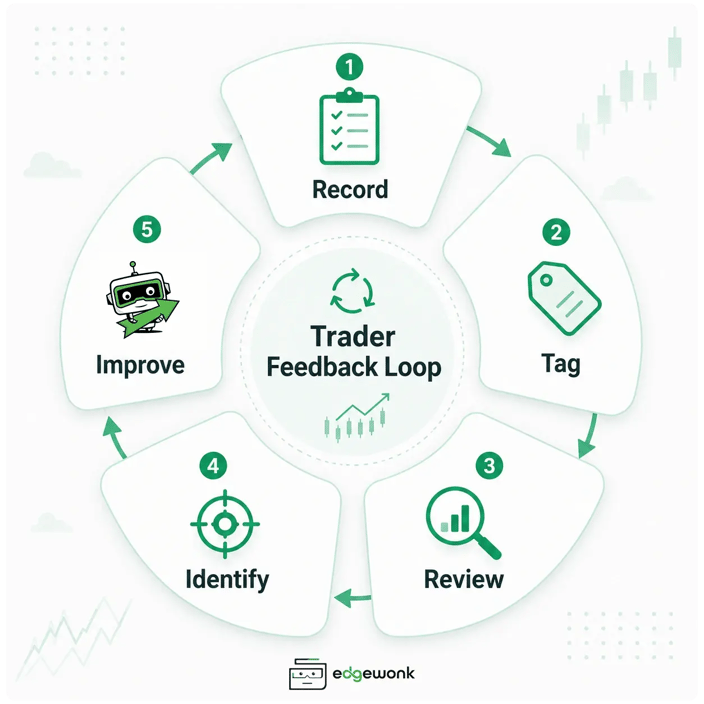
A trading journal creates a feedback loop:
This process helps traders improve in several important areas.
Find Your Best Performing Setups
Our data clearly shows that many traders use too many setups at the same time.
They may trade breakouts, reversals, pullbacks, trend continuations, news events, support and resistance, candlestick patterns, and indicator signals all inside the same account.
The problem is that not all setups perform equally well.
A trading journal helps you compare them.
You may find that your pullback trades perform well, but your breakout trades lose money. Or you may discover that one specific setup works only during certain market conditions.
Without a journal, these patterns remain hidden.
With a journal, you can focus more time and risk on the setups that actually show promise.
Identify Weak Markets or Instruments
Your performance may also differ by market.
A forex trader may perform well on EUR/USD but poorly on GBP/JPY.
A stock trader may do well with large cap momentum stocks but poorly with low volume names.
A futures trader may perform well during the New York open but poorly during midday.
A crypto trader may perform well in trending markets but poorly during choppy periods.
A journal helps you compare these differences.
This does not mean you should immediately remove every weak market. But it gives you the information needed to make better decisions.
Improve Trade Management
Trade management is one of the most overlooked areas in trading.
Many traders focus heavily on entries, but their results are often shaped by what they do after entry.
A trading journal can reveal whether you:
This is especially important because a trader can have good entries and still produce poor results through weak trade management.
Edgewonk helps traders analyze these patterns more clearly by showing how trade management decisions affect performance over time.
Separate Strategy Problems From Execution Problems
 This is one of the most important benefits of journaling.
When traders lose money, they often assume the strategy is broken.
But that is not always true.
Sometimes the strategy is fine, but the trader does not follow the rules. Other times, the trader follows the rules, but the strategy does not have a clear edge.
A trading journal helps separate these two problems.
Ask yourself:
This distinction can save traders from making the wrong changes.
If the strategy is working but execution is poor, you need to improve discipline.
If execution is good but the strategy is losing, you need to improve the system.
If both are weak, you need to simplify the process.
A structured journal helps you see which problem you actually have.
A journal only becomes useful when it is reviewed regularly and turned into clear actions.
Many traders record trades, but never review them properly. This turns the journal into a storage system instead of an improvement tool.
A simple weekly review can make a huge difference.
At the end of each trading week, ask five questions:
This does not have to take hours. The goal is to create a structured review habit.
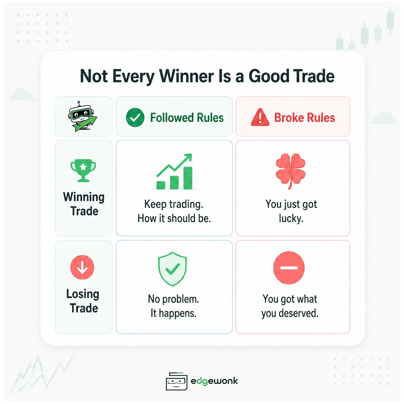
A good trade can lose.
A bad trade can win.
This is why reviewing only profit and loss is dangerous.
A profitable trade may still be a bad trade if it broke your rules. A losing trade may still be a good trade if it followed your plan and fit your strategy.
Your journal review should separate:
This helps you avoid emotional conclusions.
For example, a trader may lose three trades in a row and assume the setup no longer works. But after reviewing the journal, they may see that all three trades followed the rules and were normal losses inside the strategy.
In that case, changing the system may be unnecessary.
One trade usually does not prove much.
A single loss does not mean your strategy is broken.
A single win does not mean your strategy works.
A single mistake does not define your discipline.
The journal becomes powerful when you review repeated patterns.
Look for questions such as:
Edgewonk makes this process easier by combining trade data, tags, comments, screenshots, and analytics in one place. Instead of manually searching through a spreadsheet, traders can filter and compare their performance across setups, instruments, timeframes, emotions, and mistakes.
For a deeper review process, read our guide on how to review your trading journal.
A trading journal becomes more reliable when you stop judging single trades and start reviewing repeated patterns.
However, not all journal insights require the same amount of data.
Some behavioral patterns can appear quickly. For example, after only a few trades, you may notice that you often enter too early, hesitate on valid setups, or close winners too soon.
But performance conclusions usually require a larger sample.
As a practical guideline:
These are not fixed scientific rules. The right sample size depends on your strategy, trade frequency, timeframe, and market.
The key point is simple:
You can learn from your behavior immediately, but you should be careful when judging a strategy from only a few trades.
Many traders abandon systems too quickly because they overreact to small samples. Others keep trading weak strategies because they never review enough data properly.
A journal helps you avoid both mistakes.
It gives you a way to separate short term noise from repeated patterns.
Paper trading helps test ideas. Live trading reveals how you behave when real money is involved.
Both can be useful, but they serve different purposes.
A paper trading journal should focus on whether the strategy makes sense.
Track:
The goal is to test whether the strategy has potential and whether the rules are clear enough to follow.
Paper trading is useful because it allows you to practice without financial risk. But it does not fully recreate the emotional pressure of live trading.
Live trading adds emotion.
When real money is involved, traders often behave differently.
They may:
This is why a live trading journal should track both the strategy and the trader.
Paper trading tests the system.
Live trading tests the system and your ability to execute it under pressure.
Spreadsheets can help traders start journaling, but dedicated software makes deeper analysis and long-term consistency much easier.
The best choice depends on where you are in your trading development.
Many traders use spreadsheets because they are flexible and inexpensive.
A spreadsheet allows you to create your own fields, formulas, charts, and filters. For some traders, this is enough.
But spreadsheets also create problems.
They can become messy over time. Formulas can break. Screenshots are difficult to manage. Tags are not always consistent. Filtering and comparing setups can become time consuming. Advanced analysis often requires manual work.
This is one reason many traders start with a spreadsheet but later stop using it consistently.
The journal becomes too much effort and may lead to wrong data results.
A newer option is to use AI to code your own trading journal.
This can be attractive because AI tools can help you create spreadsheets, scripts, dashboards, or even simple web apps faster than before. Traders can ask AI to build formulas, create performance charts, calculate metrics, or design a custom journaling workflow.
This approach can work if you have technical knowledge and know exactly what you want to build.
But it also comes with several problems.
The first issue is accuracy. A trading journal needs reliable calculations. Metrics such as expectancy, drawdown, R-multiple, reward to risk ratio, trade duration, win rate, and performance by setup must be calculated correctly. If the AI-generated logic is wrong, your conclusions may be wrong too.
The second issue is maintenance. A self-built journal needs updates, bug fixes, backups, imports, data validation, and ongoing improvements. Even if AI helps you build the first version, you are still responsible for keeping the system stable.
The third issue is structure. AI can help you build a tool, but it does not automatically know what a serious trading journal should track. If your prompt is incomplete, your journal may miss important parts of the trading process, such as trade management, rule adherence, emotions, mistakes, screenshots, or review workflows.
AI can help you build something faster. But it does not remove the need for a proven journaling methodology.
Another common approach is uploading trade data into an AI tool and asking it to analyze the results.
This can be useful for quick questions such as:
This can create interesting insights, especially when the data is clean and well structured.
But there are also important limitations.
First, AI can only analyze the data you give it. If your journal does not include setup names, screenshots, emotions, trade management decisions, mistakes, or rule adherence, the AI cannot reliably analyze those areas.
Second, AI analysis is often prompt-dependent. The quality of the answer depends heavily on the quality of the question. If you do not know what to ask, you may miss the most important insights.
Third, AI may overinterpret small samples. A tool may identify patterns that sound convincing, even when the data set is too small or inconsistent to support strong conclusions.
Fourth, uploading trade data into external AI tools can raise privacy and security questions. Trade history, broker exports, strategy notes, and screenshots may contain sensitive information. Traders should be careful about where they upload their data and what the tool is allowed to do with it.
AI can be a helpful assistant. But it should not replace a consistent, structured trading journal.
Trading journal software is designed to make journaling more structured, scalable, and useful.
Good trading journal software can help with:
This is where Edgewonk comes in.
Edgewonk is designed for traders who want more than a place to store trades. It helps traders analyze setups, review trade management, track mistakes, measure discipline, and turn journal data into clear improvement steps.
A spreadsheet can tell you what your results were.
A structured trading journal can help you understand what created those results.
That difference becomes more important as your trading becomes more serious.

Edgewonk gives traders a structured online trading journal to track trades, review performance, analyze mistakes, and improve with data driven feedback.
Start Journaling With Edgewonk →
Many traders start journaling, but they do not get useful insights because they track the wrong things or never review the data.
Here are the most common mistakes.
Mistake 1: Only Tracking Profit and Loss
Profit and loss matter, but they do not tell the full story.
A winning trade can be a bad trade if you broke your rules.
A losing trade can be a good trade if it followed your plan.
If you only track results, you may reward bad behavior and punish good decisions.
A proper journal tracks both outcome and process.
Mistake 2: Writing Notes Without Structure
Some traders write long emotional notes after each trade, but they do not use consistent tags or categories.
This creates a problem later.
Unstructured notes are difficult to review. You may have useful observations, but no easy way to compare them across many trades.
A better approach is to combine short notes with structured tags.
For example:
This makes the journal easier to analyze.
Mistake 3: Tracking Too Many Metrics Too Soon
Some traders make journaling too complicated.
They try to track every possible detail from the beginning. This creates friction and makes the habit harder to maintain.
A good journal should be useful, but also realistic.
Start with the most important fields:
You can add more detail later.
Mistake 4: Reviewing Single Trades Instead of Patterns
Many traders overreact to individual trades.
They change their strategy after one loss.
They increase confidence after one win.
They abandon a setup after a small drawdown.
A journal should help you avoid this.
The goal is to find repeated patterns, not judge isolated outcomes.
Mistake 5: Not Separating Strategy Problems From Execution Problems
This is one of the biggest mistakes.
If you do not track execution quality, you cannot know whether the problem is your strategy or your behavior.
A losing period could be caused by:
The solution depends on the cause.
A good trading journal helps you identify the difference.
Mistake 6: Quitting Before the Journal Becomes Useful
Many traders stop journaling too early.
They enter trades for a few days, do not see immediate improvement, and abandon the process.
But the value of a journal builds over time.
The more consistent your data becomes, the more useful your reviews become.
The best trading journal is not the most complicated one. It is the one you can use consistently.
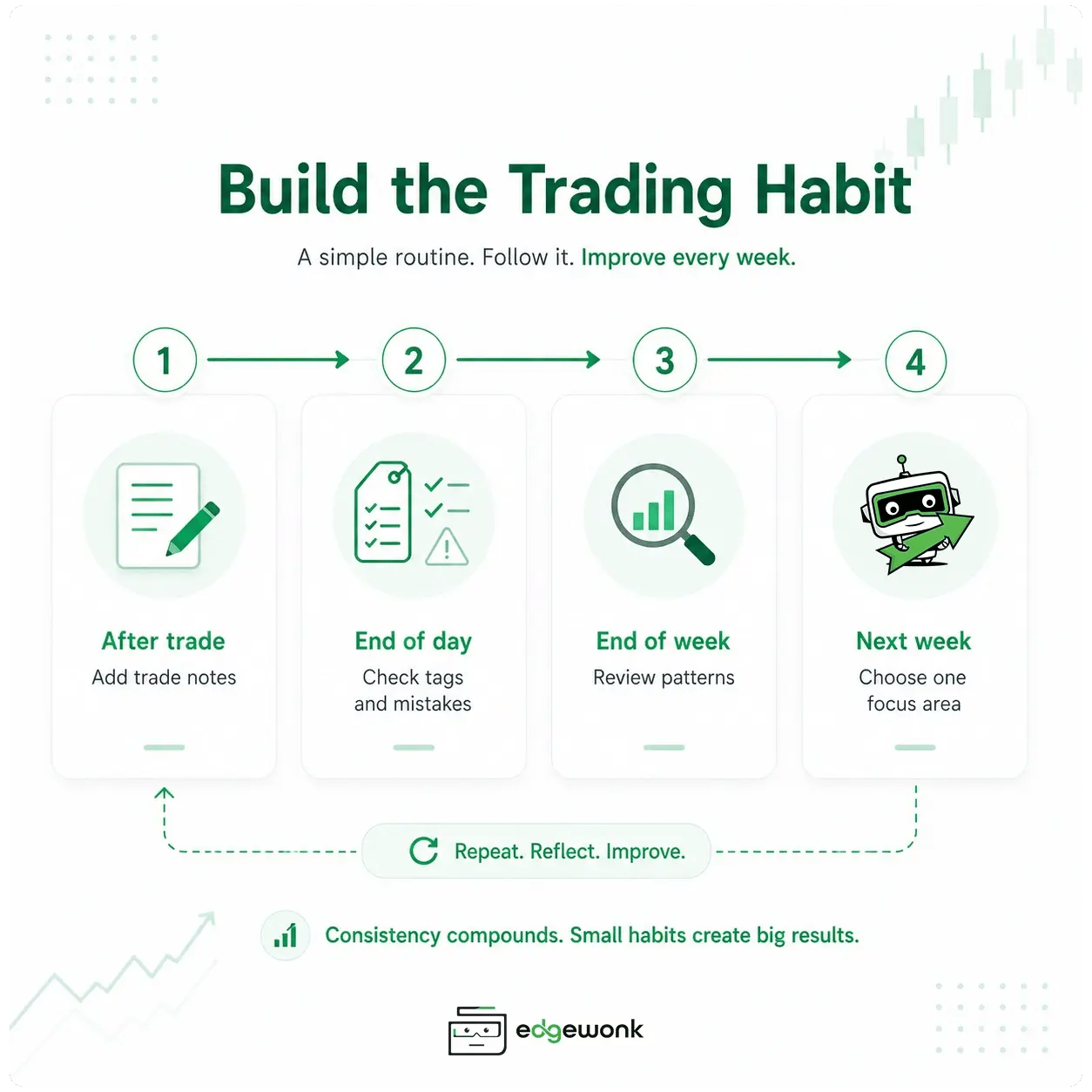
A journal only works when it becomes part of your trading process.
Tip 1: Start Simple
Do not begin with a journal that takes 20 minutes per trade to complete.
Start with the essentials:
This makes the habit easier to build.
Tip 2: Journal Immediately After the Trade
The best time to journal is shortly after the trade is closed.
Your memory is still fresh. You remember what you were thinking, how you felt, and why you made certain decisions.
If you wait too long, important details disappear. It takes less than 30 seconds to journal a trade in Edgewonk.
Tip 3: Use the Same Tags Every Time
Consistency creates better data.
Use a fixed list of setups, mistakes, emotions, and trade management tags. This makes your journaling faster and your journal becomes easier to review later.
Tip 4: Schedule a Weekly Review
Journaling after each trade is useful. But the real improvement often comes from the weekly review.
A weekly review helps you step back and ask:
This turns the journal into a feedback loop.
Tip 5: Focus on One Improvement at a Time
Do not try to fix everything at once.
Choose one focus area for the next week or month.
For example:
A journal helps you measure whether you are actually improving that one behavior.
A dedicated trading journal like Edgewonk can reduce friction because the structure is already built. Instead of deciding what to track every time, traders can follow a consistent process and focus on reviewing their performance.
The real value of a trading journal appears when your data starts pointing to specific changes.
Imagine a trader reviewing the last 50 trades and discovering the following:
Without a trading journal, the trader may simply think:
“My strategy does not work.”
But the journal tells a more specific story.
The problem may not be the entire strategy. The problem may be that the trader is mixing too many setups, trading during weak hours, and interfering with winners too early.
Based on the journal review, the trader creates a focused improvement plan:
This is how a journal creates improvement.
It does not magically make a trader profitable. But it shows where the real problems are, so the trader can work on the right things.
Without the journal, the trader guesses.
With the journal, the trader has feedback.
This is the kind of insight a structured trading journal should create.
Edgewonk is designed to help traders find these patterns faster and turn them into practical next steps. The journal review video below shows such a case from one of our traders:
What Is a Trading Journal?
A trading journal is a structured record of your trades, decisions, emotions, mistakes, and performance patterns. It helps traders understand what is working, what is not working, and what needs to improve. A good trading journal tracks more than entry, exit, and profit or loss. It also includes the setup, trade context, execution quality, emotions, rule adherence, screenshots, and review notes.
Why Is a Trading Journal Important?
A trading journal is important because it gives traders objective feedback. Without a journal, traders often rely on memory, emotions, and isolated outcomes. A journal helps identify repeated mistakes, profitable setups, weak market conditions, emotional patterns, and areas for improvement. It turns trading history into useful information.
What Should I Include in a Trading Journal?
A trading journal should include basic trade data, setup information, market context, entry reason, exit reason, risk, result, emotions, mistakes, screenshots, and review notes. The goal is to track enough information to understand both the outcome and the decision process behind each trade.
Is a Spreadsheet Enough for a Trading Journal?
A spreadsheet can be enough when you are starting out. It helps you record trades and calculate basic performance statistics. However, spreadsheets become harder to manage when you want to track screenshots, emotions, setups, mistakes, tags, trade management, and deeper performance patterns. Dedicated trading journal software can make this process easier and more consistent.
How Often Should I Review My Trading Journal?
Most traders benefit from reviewing their trading journal weekly. A weekly review helps identify recent mistakes, setup performance, rule adherence, and improvement areas. A monthly review can then be used to study larger performance trends and make strategy level decisions.
How Many Trades Do I Need Before My Journal Data Is Useful?
Some journal insights appear quickly, especially behavioral patterns such as hesitation, early exits, or revenge trading. But strategy conclusions usually require a larger sample. Many traders start seeing useful patterns after 30 to 50 trades, while stronger conclusions often require 100 trades or more.
Should Beginners Use a Trading Journal?
Yes. Beginners should use a trading journal because it builds structure, accountability, and self awareness from the start. A journal helps beginners understand their decisions, avoid repeating mistakes, and develop a more professional trading process.
What Is the Best Trading Journal Format?
The best trading journal format is one you can use consistently. It should track the numbers, the setup, the context, the decision process, the emotions, and the lesson from each trade. Beginners can start simple, while more advanced traders may need software with tags, screenshots, filters, and analytics.
Is Trading Journal Software Worth It?
Trading journal software is worth considering when you want to analyze your performance more deeply, compare setups, track mistakes, review trade management, and build a consistent improvement process. It is especially useful for traders who are serious about their trading and want to turn their trading into a profession.
Can I Use Edgewonk as My Trading Journal?
Yes. Edgewonk is an online trading journal that helps traders track trades, analyze performance, review mistakes, compare strategies, monitor discipline, and improve their trading process with structured journal data. It is designed for traders who want more than a basic trade log and want to turn their trading history into actionable feedback.
A trading journal is not just a place to record trades.
It is a performance system.
It helps you understand your decisions, review your behavior, measure your discipline, study your setups, and improve your trading process over time.
The real value of journaling is not the act of writing things down. The value comes from what you can learn after reviewing your data.
When used correctly, a trading journal can help you answer the most important trading questions:
That is how traders move from guessing to reviewing. From reacting to improving. From random trade tracking to structured performance development.
Edgewonk was built to help traders make that shift.
If you are ready to move beyond basic trade tracking, Edgewonk gives you the structure, analytics, and review tools to turn your trading journal into a true improvement process.
This week, Edgewonk received one major upgrade.
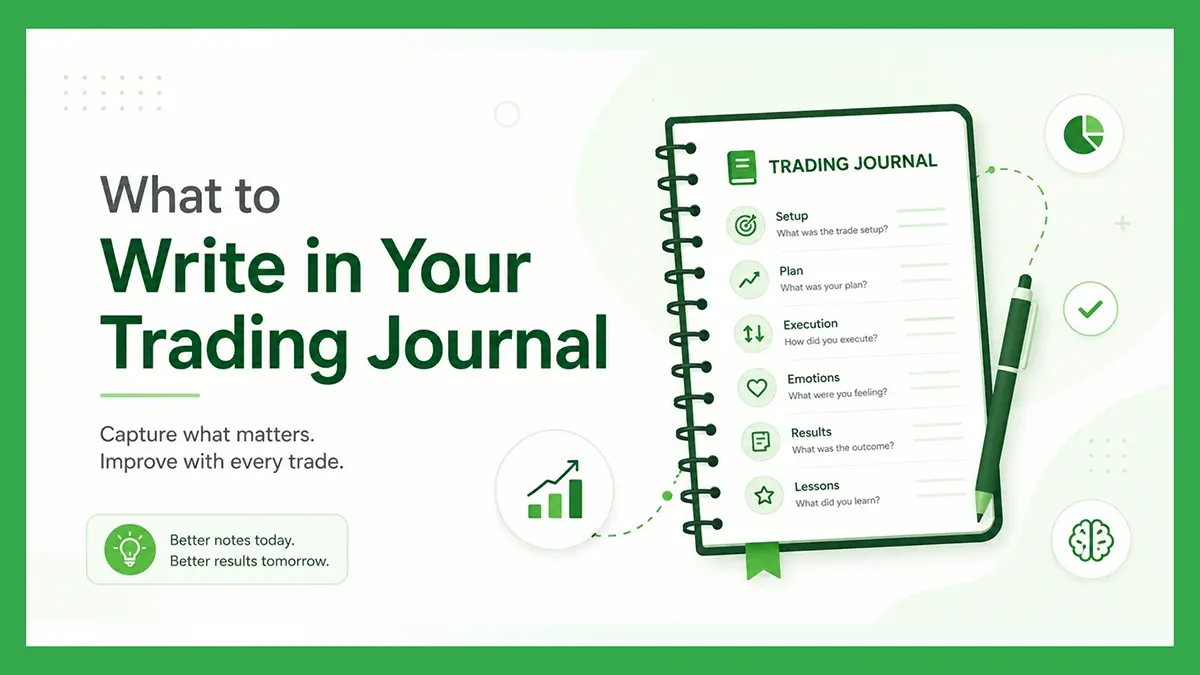
Many traders think of journaling as extra admin work after the trade is already over. But a good trading journal is not just a place where you store...
A trading journal is one of the most important tools a trader can use to improve their performance. It helps you record your trades, review your...